
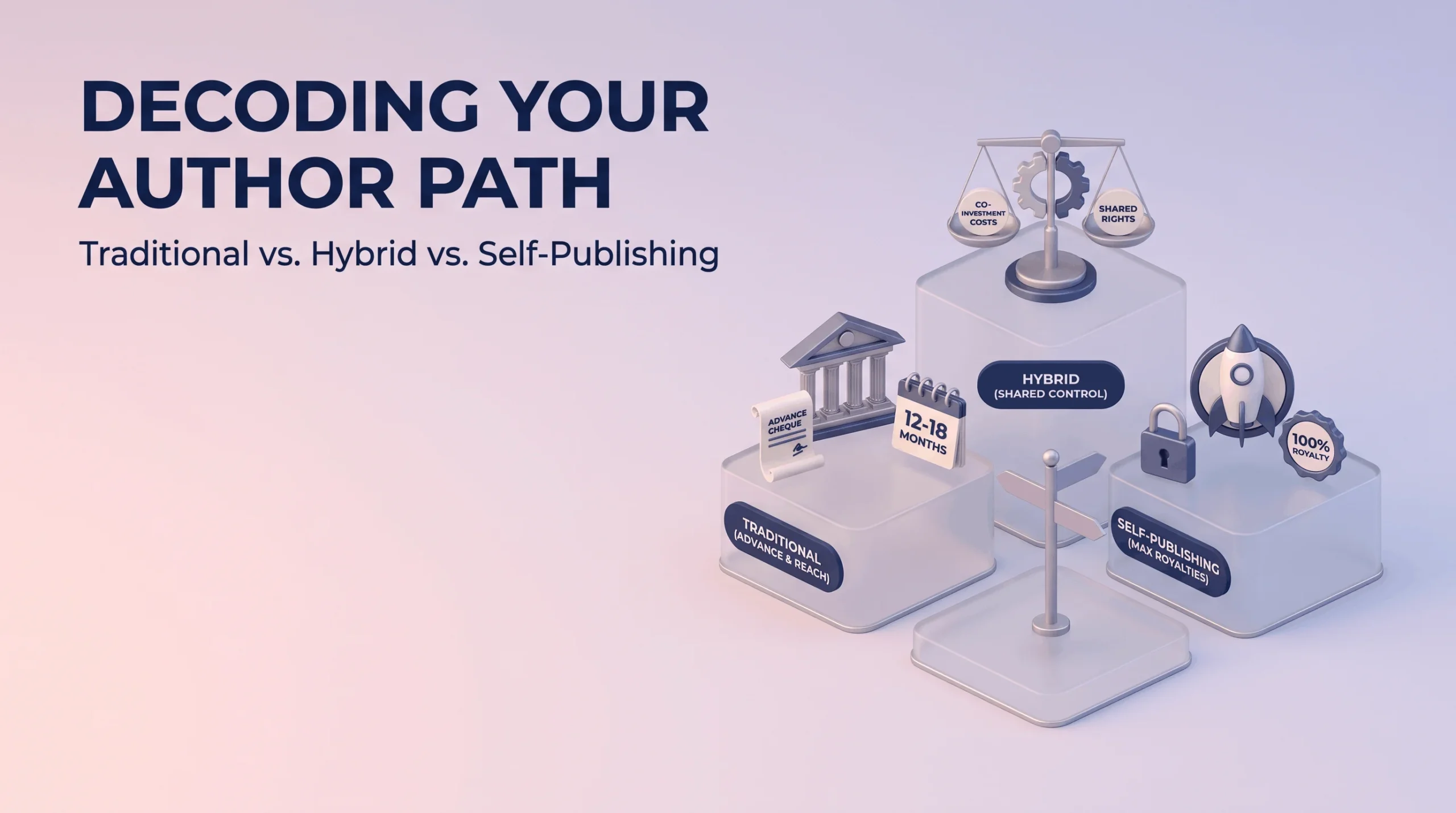
Every author eventually faces this fork, usually with far less clarity than the decision actually deserves. Here’s an honest, practical breakdown of what each path genuinely offers, without the oversimplified “traditional is better” or “self-publishing is the future” framing that oversimplifies a genuinely nuanced decision.
Advance Structures: Where the Money Actually Comes From First
Traditional publishing offers an advance payment upfront against future royalties, which must fully earn out before additional royalty payments arrive. Hybrid publishing typically involves the author covering some or all production costs upfront in exchange for more creative control and a considerably higher royalty percentage than a traditional deal offers. Self-publishing involves no advance at all, but captures the highest royalty percentage of the three paths, with all production costs and financial risk carried directly by the author.
Timeline Expectations: How Long Until an Actual Book Exists
Traditional publishing timelines routinely run twelve to eighteen months or longer from a signed contract to actual release, as a manuscript moves through a publisher’s full production and marketing calendar alongside dozens of competing titles. Hybrid publishing generally moves faster, often six to twelve months, with the author retaining more direct influence over the specific timeline. Self-publishing offers the fastest path by a wide margin weeks to a few months, entirely dependent on how quickly the author’s own team moves rather than a queue position on someone else’s release schedule.
Distribution Access: What Doors Each Path Actually Opens
Traditional publishers bring established, wide-reaching distribution relationships spanning both physical and digital retail, along with genuine access to certain media and review opportunities that remain considerably harder for independent authors to secure on their own. Hybrid publishers typically offer solid distribution, though generally narrower in scope than a major traditional publisher’s full reach. Self-publishing has expanded distribution access considerably through modern platforms, though it still requires the author to actively build and manage that access personally, rather than inheriting it automatically as part of a signed deal.
Rights Retention: What You Keep Versus What You Sign Away
Traditional contracts typically involve the publisher acquiring specific rights for a defined term, sometimes the full life of the copyright, which can meaningfully affect an author’s future ability to revise, repackage, or otherwise control their own work down the line. Hybrid and self-publishing both generally allow authors to retain considerably more rights, though contract terms genuinely vary meaningfully between individual hybrid publishers, making that fine print worth reading carefully before signing anything.
Determining the Optimal Pathway for Your Specific Book
The right path depends on what an author actually values most, honestly assessed rather than assumed. An author prioritizing wide traditional distribution, established industry credibility, and willing to trade some creative control and a larger royalty percentage for that support may find traditional publishing the stronger fit. An author prioritizing speed, full creative control, and a materially higher royalty share, comfortable managing more of the production and distribution process personally, often finds self-publishing or hybrid publishing the better strategic fit for their specific goals and available resources.
Why This Decision Deserves Real Research, Not a Default Assumption
Too many authors default toward traditional publishing simply because it’s the path they’ve always heard about, without seriously weighing whether it actually fits their specific book, genre, and career goals. Understanding what each path genuinely offers and doesn’t before committing meaningfully improves the odds of choosing a route an author won’t regret two years into an already-signed deal that no longer fits where their career has actually gone.