
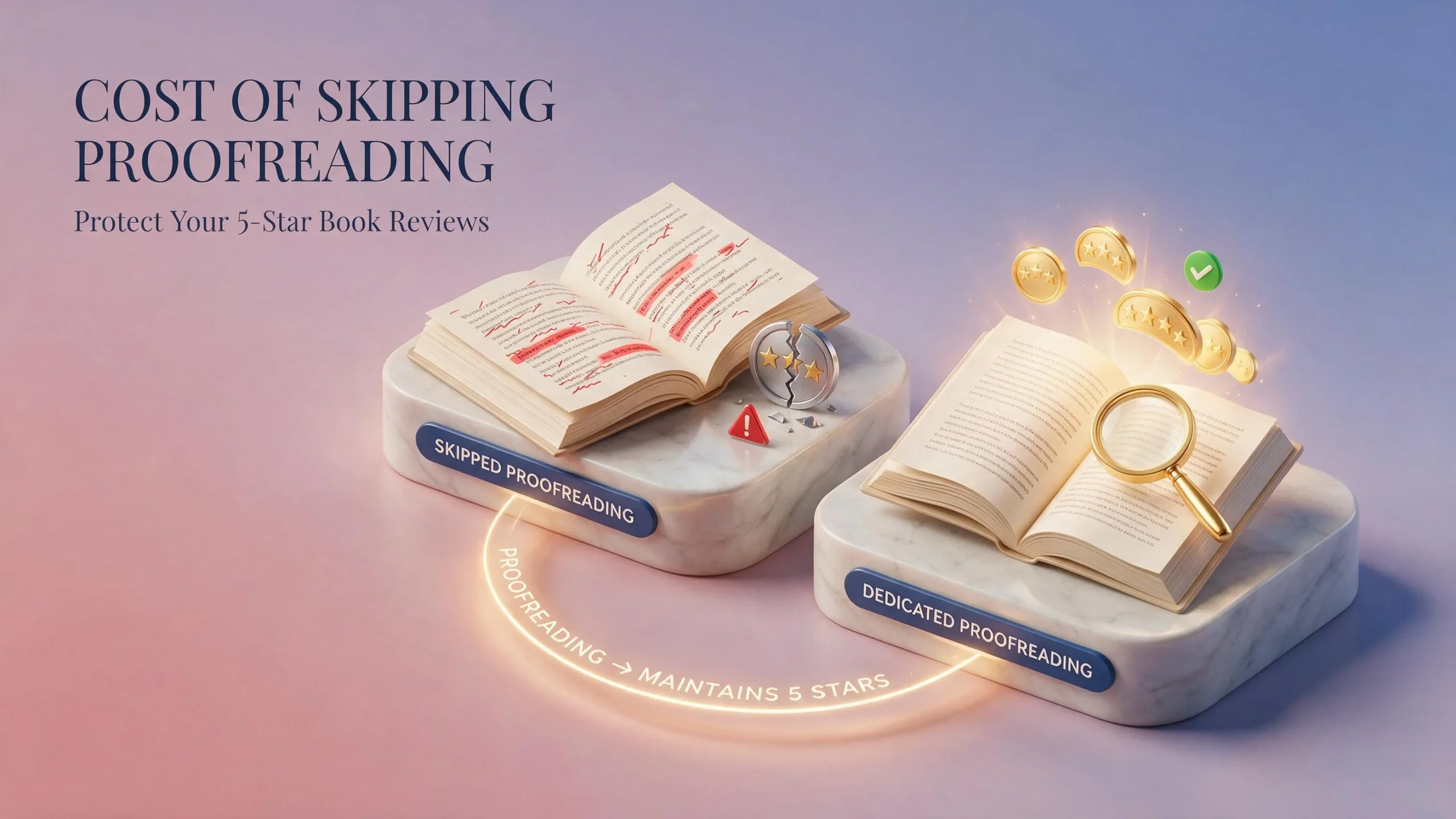
A brilliant story with sloppy execution loses readers faster than a mediocre story that’s cleanly polished. This isn’t a fair rule, and plenty of authors resent it, but it’s consistently how readers actually behave — and skipping proofreading to save a modest cost upfront routinely costs far more in lost reviews and stalled word-of-mouth down the line.
The Impact of Typos on Reader Trust
A single typo early in a book rarely sinks it. A pattern of typos, inconsistent formatting, or grammatical errors scattered throughout signals something more damaging to a reader: that the author, or the publishing process behind the book, didn’t take the work seriously enough to catch obvious problems. That impression bleeds into how readers judge everything else about the book, including the actual story quality, whether that judgment is fair or not.
How Amazon Review Algorithms Factor Into This
Amazon’s recommendation system weighs review sentiment and rating distribution when deciding how prominently to surface a book to new potential readers. A pattern of reviews specifically mentioning “needs editing,” “full of typos,” or “poorly proofread” doesn’t just lower a star rating — it actively signals lower quality to the algorithm deciding who sees your book next, creating a compounding disadvantage that a single edited-and-relaunched version can partially repair but never fully erase from the review history.
Why Proofreading Errors Get Called Out Publicly More Than Structural Ones
Readers who notice a slightly underdeveloped subplot rarely mention it in a review — that’s a subjective, hard-to-articulate critique most casual reviewers don’t bother writing out. A typo, though, is easy to spot and easy to call out specifically: “found several typos throughout” is a common, quick review line precisely because it’s concrete and doesn’t require literary analysis to identify. This means proofreading errors get disproportionately represented in negative reviews relative to how much they actually affected the reading experience.
The Role of Book Proofreading Services in Catching What Editing Misses
Developmental editing and copyediting focus on structure and sentence-level clarity — proofreading is the dedicated final pass specifically hunting for the small, easy-to-miss errors that survive even careful earlier editing rounds. Book Proofreading Services run by someone who wasn’t involved in the earlier editing stages bring genuinely fresh eyes, catching what an editor too familiar with the manuscript by that point has started to read past without consciously registering.
Final Quality Control: The Step Authors Skip Under Deadline Pressure
Under launch deadline pressure, proofreading is frequently the stage that gets rushed or cut entirely — it happens last, after every other editing decision has already consumed the available budget and timeline. This is precisely backward from a risk standpoint: skipping developmental editing risks a structurally weaker book that readers might still enjoy despite its flaws, while skipping proofreading risks visible, easily-cited errors that actively damage the reviews controlling whether new readers ever discover the book in the first place.
Making the Case for Proofreading as Non-Negotiable
A single dedicated proofreading pass costs meaningfully less than developmental editing or full copyediting, and it protects against the specific type of criticism that shows up publicly, in writing, on a review page every future potential reader will see before deciding whether to buy. Treating proofreading as an optional final step, rather than a required stage every manuscript goes through before publication, is one of the most common and most avoidable mistakes in self-publishing — and one of the cheapest to actually fix.