
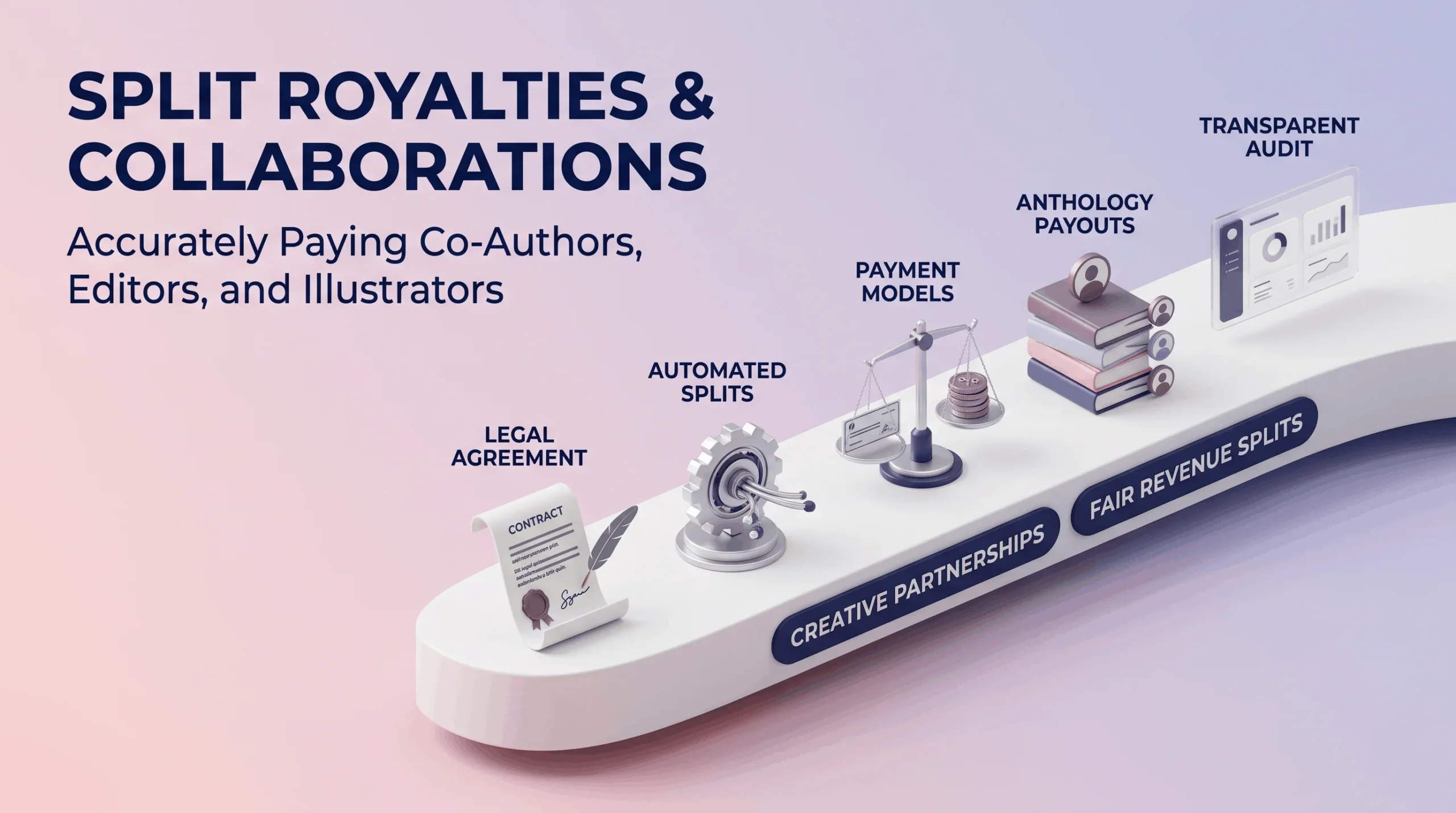
Collaborative books co-authored novels, anthologies, heavily illustrated titles with a named artist introduce a financial complexity solo-authored books simply never have to deal with. Getting the money right matters just as much as getting the writing right, and it’s a genuinely common source of preventable friction between collaborators when it isn’t handled carefully.
Best Practices for Managing Shared Earnings From the Start
Every collaborative project should establish exact royalty split percentages in writing before any actual writing or illustration work begins, not after the book is already generating real revenue and everyone’s expectations have quietly begun to diverge. Clear upfront agreement prevents the ambiguity that turns a simple, straightforward payment into a genuinely uncomfortable conversation between collaborators months into a project.
Automated Percentage Splits: Removing Human Error From the Equation
Manually calculating and distributing split payments across multiple contributors, especially across multiple platforms and currencies simultaneously, introduces real opportunity for simple math errors that quietly erode trust between collaborators over time. Automated percentage-split systems apply the agreed division consistently to every single sale, removing manual calculation entirely from the process and giving every contributor identical, transparent visibility into exactly how their specific share got calculated.
Legal Contracts: The Foundation Every Collaboration Actually Needs
A proper collaboration agreement should specify exact royalty percentages, payment frequency, and what happens in specific edge cases what if one contributor wants to exit the project partway through, or the book generates unexpected income from a source nobody originally anticipated, like a foreign translation deal. Addressing these scenarios in writing before they actually arise prevents exactly the kind of dispute that can genuinely derail a working relationship between people who otherwise collaborate well together.
Avoiding Payment Disputes Through Genuine Transparency
Most collaboration disputes over money stem from a basic lack of visibility one contributor genuinely suspecting, whether accurately or not, that they’re not receiving their fair, agreed share, with no easy way to independently verify the actual numbers themselves. Transparent, automated reporting that every contributor can access directly removes this specific suspicion entirely, since everyone sees the identical underlying sales data and the identical calculation applied consistently to that data.
Editors and Illustrators: When They’re Owed Royalties Versus a Flat Fee
Not every contributor works on a royalty-split basis many editors and illustrators work for a flat, one-time fee instead, with no ongoing stake in future earnings at all. Clarifying this distinction upfront, in writing, prevents a genuine and understandable misunderstanding later about whether a specific contributor is actually owed an ongoing percentage of sales or was already fully compensated through their original flat-fee payment.
Handling Anthology Projects With Multiple Contributors
Anthologies with numerous contributing authors need a clearly defined, agreed-upon method for dividing revenue equal splits regardless of individual story length, splits proportional to word count, or splits based on some other clearly agreed metric decided upfront. Whichever specific method gets chosen, it needs to be documented clearly and calculated consistently across every single sale, not applied inconsistently or renegotiated informally after the book is already live and generating revenue.
Why Getting This Right Protects Working Relationships, Not Just Money
Collaborative publishing projects frequently lead to further creative partnerships when the financial side is handled cleanly, transparently, and without ongoing friction. Conversely, a poorly managed split can genuinely sour an otherwise strong creative partnership over what often turns out to be a comparatively small sum of money, made disproportionately worse purely by a lack of clarity and transparency rather than any actual bad faith on anyone’s part. Getting the financial structure right from day one protects the creative relationship every bit as much as it protects everyone’s actual earnings.