
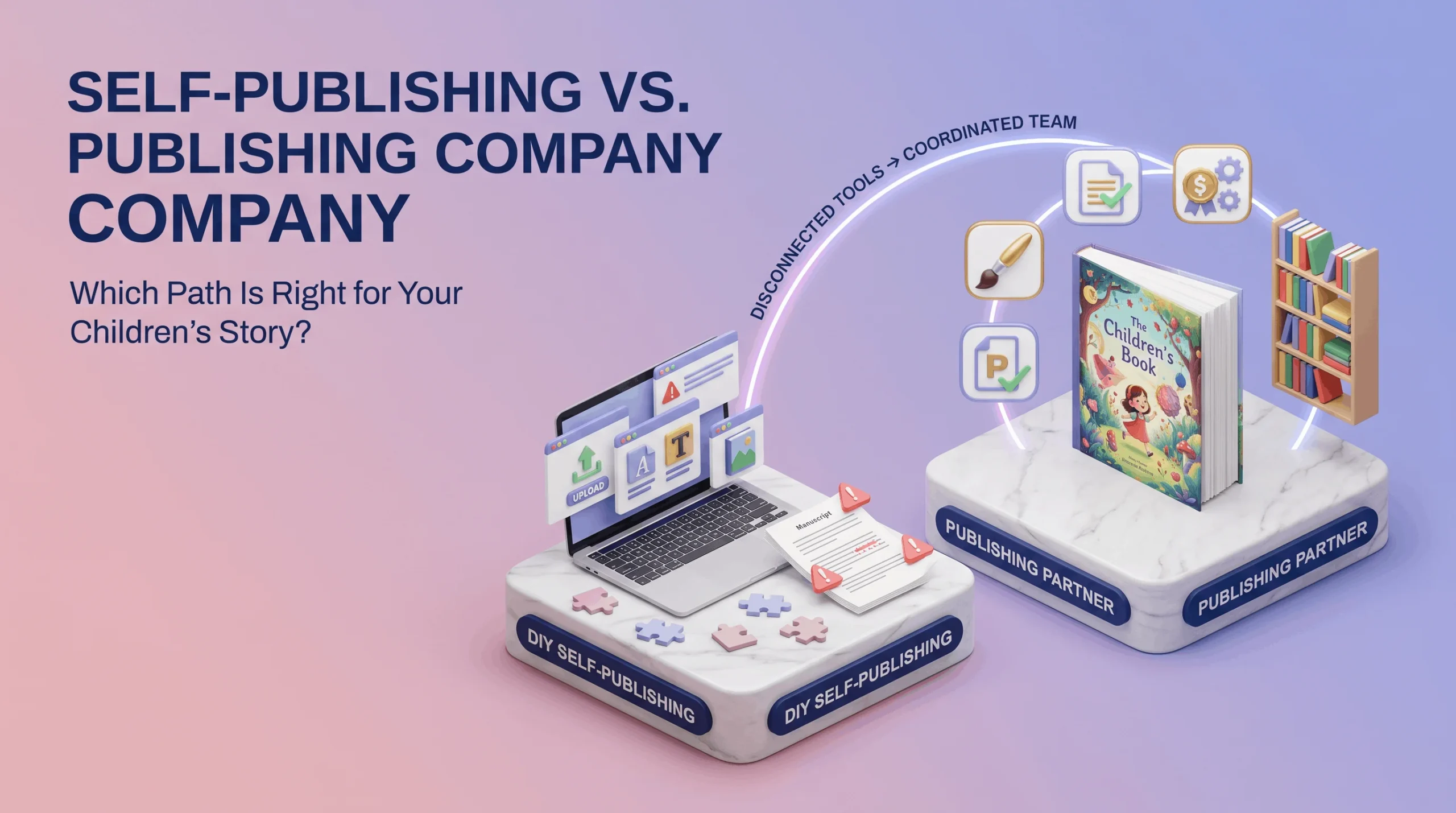
Every author writing for young readers eventually faces the same fork: piece the process together alone through a self-publishing platform, or bring in a Children Book Publishing company to manage illustration, formatting, and print together. Both paths can produce a finished book. They rarely produce the same finished book and understanding why matters before you commit months of work to either one.
What Self-Publishing Actually Asks of You
A self-publishing platform gives you the tools upload interfaces, print-on-demand infrastructure, distribution checkboxes and leaves the execution decisions entirely in your hands. For a novel, that’s often manageable; the format is largely just text. For a children’s book, it means personally sourcing and directing an illustrator, understanding trim size and age-category conventions well enough to choose correctly, managing color calibration between screen and print, and troubleshooting file specification mismatches when a printer rejects a submission for reasons that were never explained clearly upfront. None of this is impossible to learn. It is, however, a genuinely steep learning curve to absorb for a single book, and most of the expensive mistakes happen on the first attempt exactly when an author can least afford them.
What Changes With Professional Children Book Publishers
Working with established Professional children book publishers doesn’t remove your creative control it removes the burden of solving problems that hundreds of prior titles have already solved. Character consistency across pages, age-appropriate vocabulary banding, correct trim size for your category, bleed margins that won’t leave white slivers on a finished page these become managed decisions handled by people who’ve made them correctly before, rather than trial-and-error learned at your own expense.
The Cost Comparison Isn’t as Simple as It Looks
DIY self-publishing often looks cheaper upfront, and sometimes it is. But the comparison rarely accounts for hidden costs: a freelance illustrator unfamiliar with children’s-specific continuity requirements, a reprint triggered by uncalibrated color, or months lost coordinating between vendors who’ve never worked together before. Comprehensive Children’s Book Publishing services fold illustration, formatting, and print preparation into one coordinated process which frequently ends up more cost-efficient than the DIY path once every correction and delay gets tallied honestly.
When DIY Self-Publishing Genuinely Makes Sense
This isn’t a blanket case against self-publishing. An author with real design or illustration experience, comfortable navigating print specifications independently, and working on a passion project rather than a title meant for wide retail placement, may reasonably choose the DIY route and do it well. The calculation shifts specifically when a book is meant for school, library, or broad retail distribution markets where execution quality and correct specification matter more, and where a single rejected file or inconsistent illustration can quietly cost a placement opportunity.
What to Look for If You Choose a Publishing Partner
Not every Children Book Publishers in USA option offers the same depth of service. Ask specifically whether illustration is handled in-house or outsourced to a disconnected freelancer, whether royalty reporting is transparent and real-time, and whether you retain full ownership of both your text and your commissioned artwork. Trinity Publishing Press manages illustration direction, formatting, and print specification under one coordinated team specifically to avoid the handoff gaps that cause most first-time children’s books to stumble while ensuring authors keep 100% of their royalties and full rights to their story and its artwork.
Making the Decision
The right choice isn’t about which path is universally better it’s about matching the path to your book’s goals, your available time, and your comfort with the technical side of print production. A story meant to sit on a family bookshelf can thrive either way. A story meant to reach school libraries, national retail shelves, or a wide readership benefits substantially from the coordination a dedicated Children Book Publishing company already has in place. Know which book you’re actually trying to publish before choosing how to publish it.