
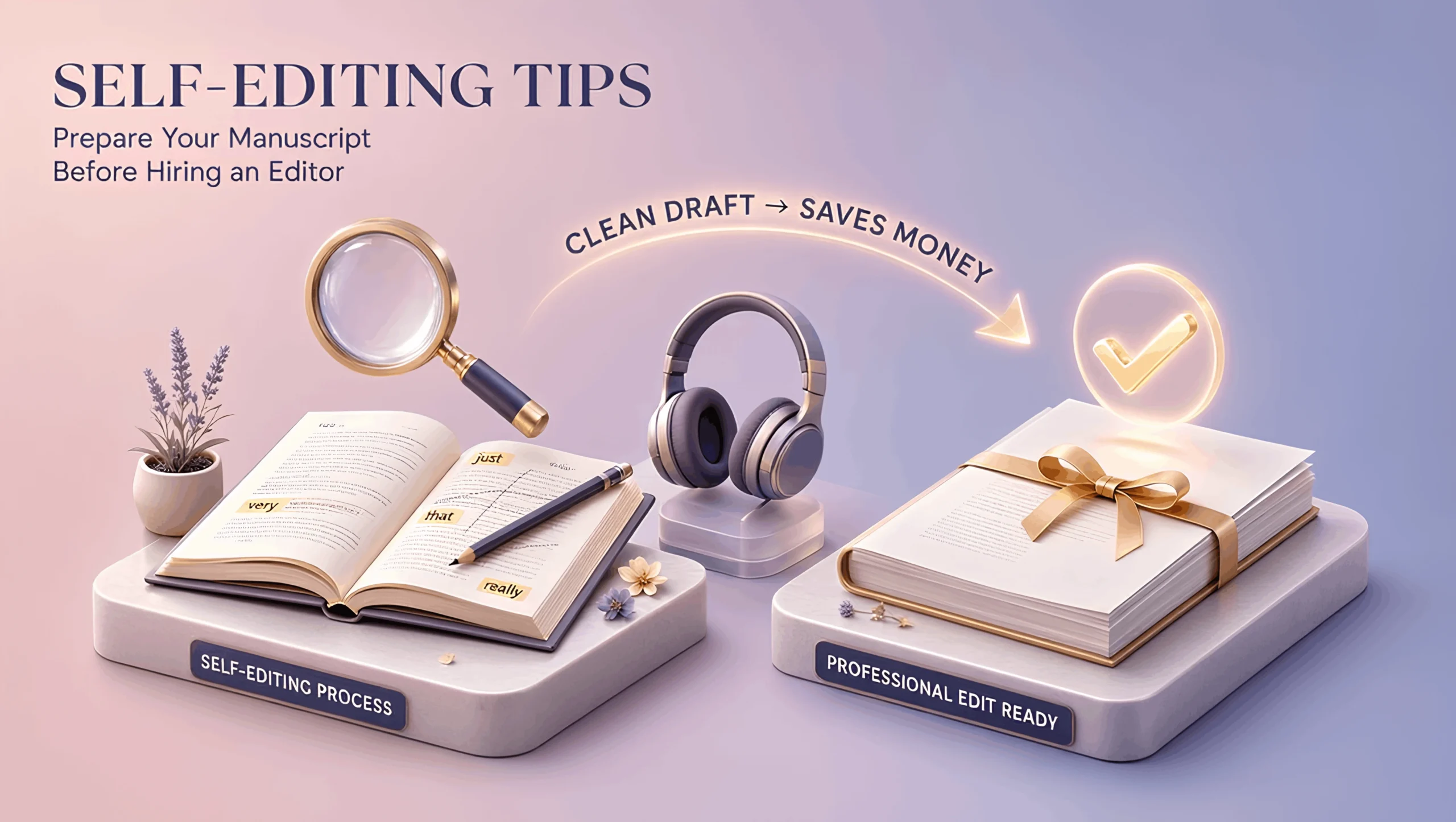
A professional edit costs less, in both money and time, when it’s working with a manuscript that’s already had the obvious problems cleared out. Here’s what to fix yourself first, before you hire a professional book editor to handle the work that actually requires a trained outside eye.
Cutting Fluff Words That Quietly Weaken Every Sentence
Words like “just,” “very,” “really,” “actually,” and “somewhat” sneak into first drafts constantly, softening sentences that would hit harder without them. “She was very tired” reads weaker than “She was exhausted.” Running a search for your most common filler words and evaluating each instance individually — does this word add real meaning, or is it just verbal padding — tightens prose noticeably before an editor ever sees the file.
Fixing Filter Verbs That Distance Readers From the Story
Filter verbs — “she saw,” “he felt,” “I noticed,” “they heard” — insert an unnecessary layer of narrative distance between the reader and the actual experience being described. “She saw the door open” reads with less immediacy than simply “The door opened.” Searching your manuscript for these filter constructions and removing the unnecessary framing, where the perspective character is already established, tightens the prose and pulls readers more directly into each scene.
Spotting Passive Voice Before It Becomes a Habit
Passive voice — “the ball was thrown by John” instead of “John threw the ball” — isn’t always wrong, but it’s overused constantly in first drafts, and it tends to drain sentences of energy and immediacy. Most word processors flag passive constructions automatically, and reviewing each flagged instance individually, converting to active voice where it genuinely improves the sentence, is a mechanical fix any author can do without editorial training.
Running Spell-Checks Properly, Not Just Once
A single spell-check pass at the end of a draft misses more than most authors expect, particularly homophone errors — “their” versus “there,” “its” versus “it’s” — that pass spell-check cleanly because both versions are technically correctly spelled words. Reading your manuscript specifically for these commonly confused word pairs, ideally aloud or with text-to-speech, catches errors a standard spell-check tool structurally can’t flag on its own.
Reading Your Manuscript Aloud Before Sending It Anywhere
This sounds almost too simple to matter, and it consistently catches more than authors expect. Awkward phrasing that reads fine silently often sounds clearly wrong once spoken aloud — a sentence that’s technically grammatical but doesn’t actually flow naturally in speech. Dialogue benefits enormously from this test specifically, since dialogue that sounds stilted read aloud will read exactly that way to a reader’s internal voice as well.
Preparing a Genuinely Clean Draft to Save Real Money
Editing services are frequently priced per word or per hour, which means a manuscript full of easily self-correctable errors costs more to edit than one that’s already had an honest self-editing pass. Every fluff word cut, every filter verb removed, every passive construction converted before submission is time an editor doesn’t need to spend on mechanical fixes — time that gets redirected toward the substantive structural and stylistic work only a trained editor can actually provide.
Knowing Where Self-Editing Stops and Professional Editing Starts
Self-editing catches surface-level issues effectively, but it has real limits — an author is too close to their own manuscript to spot every structural problem, every underdeveloped character arc, every plot thread that doesn’t fully resolve. That’s precisely the gap a professional editor closes, bringing genuine outside perspective and trained pattern recognition to problems an author’s own familiarity with the material makes genuinely difficult to see clearly. Self-editing and professional editing aren’t competing approaches — they’re sequential steps, each doing the specific job the other one can’t.