
Ask ten authors what format their eBook should be, and most won’t have a strong opinion until their cookbook’s beautifully arranged recipe layout turns into a scrambled mess of floating text and misplaced images on a Kindle. That’s usually the moment reflowable versus fixed layout stops being a technical footnote and starts being the reason a launch gets delayed.
What Reflowable Layout Actually Does
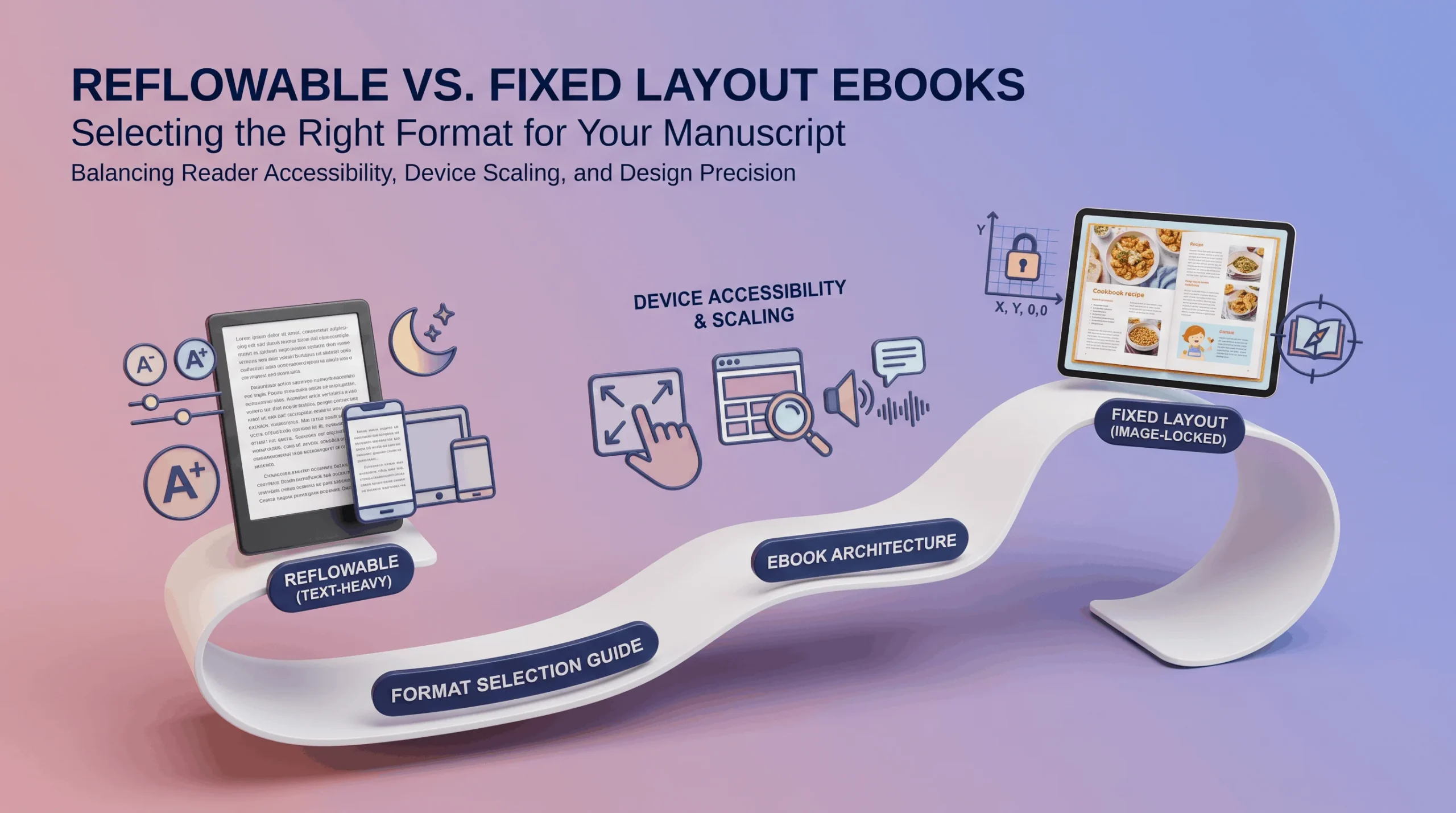
Reflowable formatting treats your text like water it fills whatever container it’s given. A reader bumps the font size up two notches, and every line, paragraph, and page break recalculates on the fly to fit. This is the default for standard fiction and text-heavy nonfiction, and for good reason: readers with vision differences, readers on a phone versus a tablet, readers who just prefer larger type at night all of them get a comfortable experience without the author needing to design for every possible screen size individually.
What Fixed Layout Locks Down
Fixed layout does the opposite. Every element text block, image, caption sits at an exact coordinate that doesn’t move regardless of screen size or font preference. This matters enormously for anything where positioning carries meaning: a cookbook where the ingredient list needs to sit precisely next to its matching photo, a children’s picture book where text wraps intentionally around an illustration, a graphic-heavy nonfiction title where captions need to stay locked to specific images.
The Cookbook Problem, Explained
Picture a recipe book converted with reflowable settings by mistake. The ingredient list that was designed to sit in a neat sidebar next to a photo instead flows below three paragraphs of unrelated text, because reflowable formatting doesn’t understand “this list belongs visually next to this specific image” it just flows content in document order. The result reads like a formatting accident, because it is one. Recipe books, children’s books, and heavily illustrated nonfiction need fixed layout specifically to avoid this exact failure.
The Novel Problem, Reversed
Now flip it. A three-hundred-page novel forced into fixed layout becomes a technical nightmare and a reader complaint magnet text that doesn’t resize means a reader with low vision can’t increase font size, page counts balloon awkwardly across devices, and file sizes grow far larger than they need to for what’s fundamentally a text-only reading experience. Fixed layout on a standard novel isn’t just unnecessary. It actively makes the reading experience worse.
Device Scaling: Why This Decision Compounds
Readers today move between a phone, a tablet, an e-reader, and occasionally a laptop screen, often within the same week of reading one book. Reflowable content adapts automatically across every one of those screen sizes. Fixed layout content, designed at one specific dimension, can end up requiring pinch-to-zoom on a smaller device technically readable, practically annoying, and a real reason readers abandon a book they’d otherwise have finished.
User Reading Controls Matter More Than Authors Expect
Font size adjustment, line spacing, night mode, text-to-speech compatibility these reader-side controls generally only function properly with reflowable content, because fixed layout locks the visual presentation in a way that resists exactly the kind of adjustment these features rely on. An author who assumes “fixed layout looks more polished, so I’ll use it everywhere” is often unknowingly stripping away accessibility features a meaningful portion of their audience actually relies on.
Making the Right Call for Your Manuscript
The decision isn’t about which format looks more premium it’s about what your specific content actually needs to display correctly. Text-dominant books, virtually always reflowable. Anything where image and text position carry real meaning cookbooks, children’s books, heavily designed nonfiction fixed layout, without exception. Getting this choice wrong doesn’t just create a formatting inconvenience. It can mean a launch-week flood of one-star reviews complaining about a broken-looking book, for a manuscript that was never actually broken just built in the wrong format from the start.