
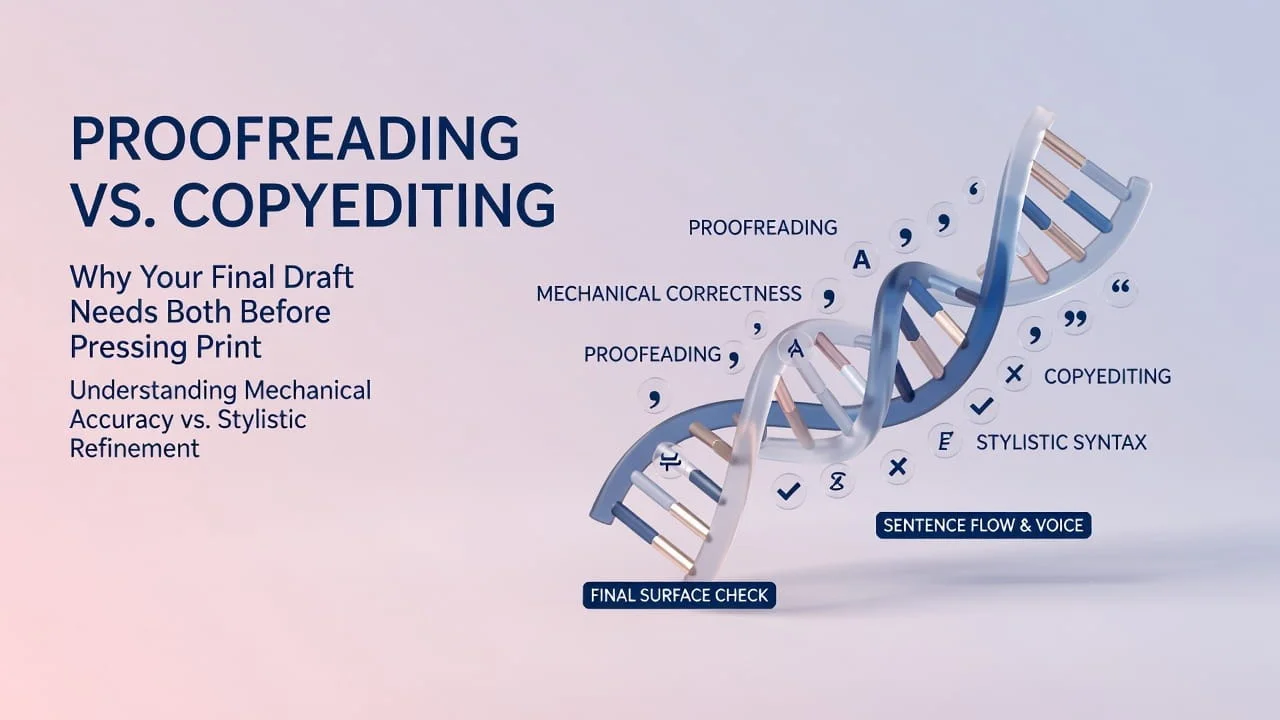
Authors frequently treat proofreading and copyediting as interchangeable, or worse, as one optional step they can afford to skip if the budget’s tight. They’re genuinely different stages doing genuinely different jobs, and skipping either one leaves a specific, predictable kind of damage in the finished book.
Mechanical Error Correction: What Proofreading Actually Targets
Proofreading operates at the surface level spelling, punctuation, spacing, formatting consistency, and the small mechanical slips that don’t require any judgment call about style or voice, just accuracy. A proofreader isn’t asking whether a sentence could be phrased more elegantly; they’re asking whether it’s grammatically and mechanically correct exactly as written. This is detail-oriented, pattern-recognition work, catching a missing closing quotation mark or an inconsistently capitalized character name across three hundred pages.
Stylistic Syntax Adjustments: What Copyediting Actually Targets
Copyediting operates one level up, addressing sentence structure, word choice, clarity, and stylistic consistency questions with genuine judgment involved, not just mechanical correctness. A copyeditor might restructure an awkward sentence, flag repetitive word choice, or smooth transitions between paragraphs that technically work but read clunky. This requires a trained editorial eye evaluating quality and flow, not simply verifying accuracy against fixed grammatical rules.
Why the Two Stages Genuinely Need to Happen Separately
Running both stages together, or skipping straight to proofreading without a copyediting pass first, tends to produce a manuscript that’s technically correct but still reads awkwardly in places a copyeditor would have caught and smoothed. Running copyediting without a subsequent proofreading pass leaves exactly the kind of small mechanical errors a copyeditor, focused on bigger structural and stylistic questions, is genuinely more likely to read past without consciously registering them.
Timing: Why Order Actually Matters Here Too
Copyediting should happen first, while larger stylistic and structural decisions are still being finalized there’s little point proofreading a sentence’s punctuation if that same sentence might get substantially restructured during copyediting anyway. Proofreading comes last, after every other editorial decision has genuinely been made, serving as a final, focused check rather than an earlier-stage catch-all trying to do too many different jobs simultaneously.
Why Skipping Proofreading Specifically Damages Author Credibility
Here’s the part that catches authors off guard: readers rarely mention an awkward sentence structure in a review, because that critique requires a level of craft analysis most casual readers don’t articulate. A typo, though, is easy to spot and easy to call out directly “found several typos” is a common, quick review line precisely because it requires no literary analysis to identify and write. This means proofreading errors get disproportionately represented in negative reviews relative to how much they actually affected the reading experience, and that public, easily-cited criticism does real damage to an otherwise well-written book’s reputation.
The Combined Effect of Skipping Either Stage
A manuscript with copyediting but no proofreading reads well sentence to sentence but carries small, distracting errors readers notice and specifically mention. A manuscript with proofreading but no copyediting is technically clean but might read stiffly, with awkward phrasing a copyeditor would have smoothed. Neither gap is minor, and neither substitutes for the other they’re addressing genuinely different problems that both need solving before a manuscript is actually ready for readers.
Making Sure Your Final Draft Gets Both
Budget and timeline for both stages as distinct, necessary steps rather than treating one as optional if resources get tight. A manuscript that’s been through genuine copyediting and a separate, dedicated proofreading pass reads polished at both the sentence level and the surface level the combination readers actually notice, even when they can’t quite articulate what specifically made a book feel “professionally done.”