
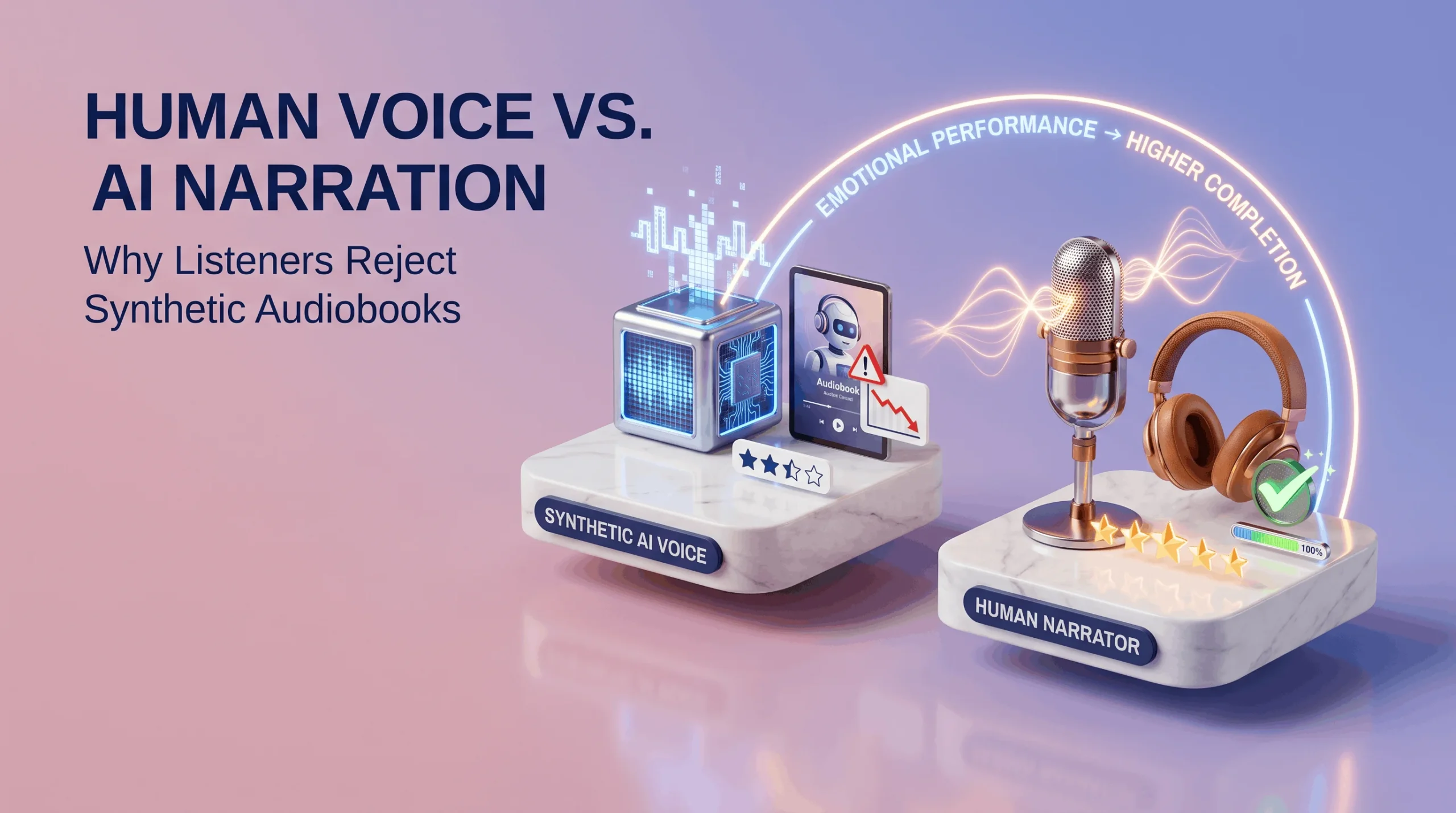
AI narration has gotten noticeably better over the past few years better pronunciation, fewer robotic artifacts, more natural pacing on a sentence-by-sentence basis. And listeners still overwhelmingly reach for human-narrated audiobooks when given a real choice. The reason isn’t nostalgia. It’s that fiction and memoir ask a narrator to do things synthetic voice generation still can’t reliably manage.
Emotional Pacing Is Where Synthetic Voices Break Down First
A grieving character’s pause before speaking carries meaning. A moment of dawning realization needs a specific shift in tempo and breath to land the way the writing intends. Human narrators make hundreds of micro-decisions per chapter about exactly how long to hold a pause, where to let a sentence trail rather than snap crisp decisions rooted in genuinely understanding what’s emotionally happening in the scene, not pattern-matching against training data. AI narration tends to apply relatively uniform pacing regardless of emotional content, which technically sounds fine and somehow drains scenes of the weight they were written to carry.
Character Voice Distinction Is a Real Skill, Not a Setting
A novel with five distinct characters needs five distinguishable voices, and a trained narrator builds those distinctions through pitch, pacing, and vocal texture shifts that stay consistent across an entire multi-hour recording. Current AI narration systems generally apply either one consistent voice throughout or require separately generated voice models stitched together neither approach handles the natural, fluid character-switching a skilled human narrator manages within a single continuous performance, especially in dialogue-heavy scenes where characters interrupt or overlap each other.
Tone Inflection: The Detail That Separates Reading From Performing
There’s a real difference between reading a sentence aloud and performing it. Sarcasm, genuine warmth, barely-controlled anger these come through in specific vocal inflection choices a trained narrator makes instinctively based on context, subtext, and everything they know about where a scene is heading. AI-generated narration, even sophisticated versions, tends to default toward a neutral-to-pleasant delivery that misses the specific edge a line needs, technically correct pronunciation paired with an emotional flatness listeners pick up on almost immediately, even when they can’t articulate exactly what feels off.
Listener Retention Tells the Real Story
Completion rate data across major platforms consistently favors human-narrated titles over AI-narrated ones in the same genre and price range. Listeners abandon books for specific, identifiable reasons narration that feels flat, pacing that drags, a voice that doesn’t match the material’s tone and synthetic narration triggers these abandonment patterns more frequently than professional human narration does, even when the AI voice is technically clear and easy to understand on a purely mechanical level.
Why Audible’s Algorithm Actively Favors Human Narrators
Audible’s recommendation system weighs completion rate and listener engagement heavily when deciding what to surface to new listeners. A book that loses listeners early in chapter two, regardless of the reason, gets recommended less which means the emotional flatness synthetic narration sometimes produces doesn’t just cost individual listener satisfaction, it actively suppresses a book’s algorithmic visibility over time, creating a compounding disadvantage that’s difficult to reverse once it takes hold.
The Trade-Off Authors Are Actually Making
AI narration is faster and considerably cheaper, and for certain limited use cases a quick informational piece, content where emotional performance genuinely doesn’t matter that trade-off can make sense. For fiction, memoir, or anything relying on emotional connection to hold a listener’s attention across several hours, the gap in performance quality translates directly into lower completion rates, weaker reviews, and reduced algorithmic reach. A professional audiobook creation service built around real human narrators isn’t a nostalgic preference. It’s the version listeners actually finish.