
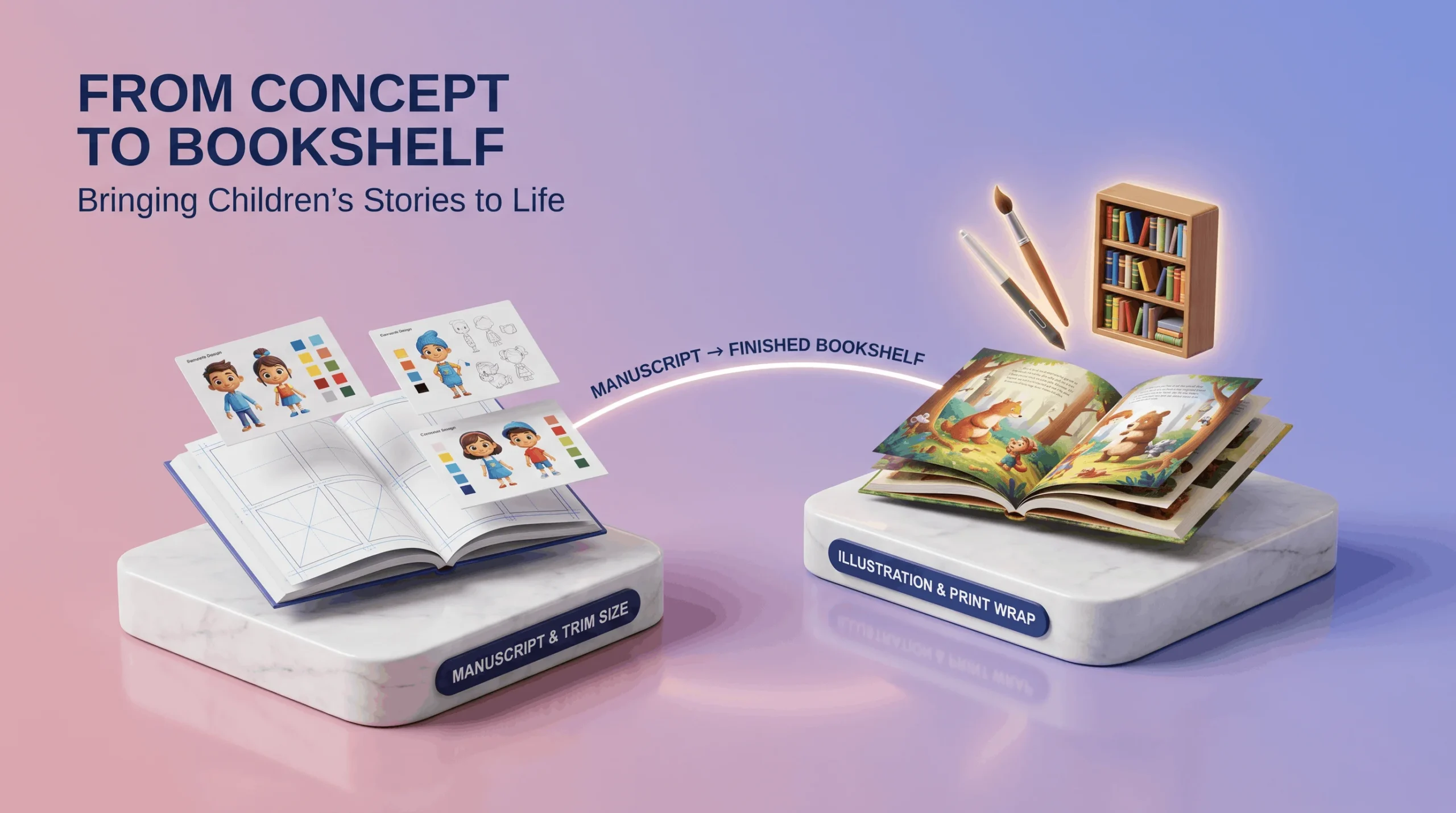
A children’s manuscript looks deceptively simple on the page short sentences, a handful of characters, maybe thirty-two pages. What actually happens between that manuscript and a finished book involves more technical decision-making than most first-time authors expect, and getting even one of those decisions wrong is usually what separates a book that reads well from one that simply looks unfinished.
Trim Size Isn’t a Design Preference It’s a Category Signal
Trim size communicates genre and age group before a reader even opens the cover. An 8×8-inch square format reads instantly as a picture book aimed at younger children; a 5.5×8.5-inch format signals a chapter book or early reader aimed at slightly older kids already comfortable with more text per page. Choosing a trim size that doesn’t match reader expectations for the category creates quiet friction at the point of purchase a parent or librarian scanning a shelf makes snap judgments based on format before reading a single word of the description.
Age-Group Categorization Drives Every Downstream Decision
Board books (ages 0-3), picture books (ages 3-8), early readers (ages 5-7), chapter books (ages 6-10), and middle-grade titles (ages 8-12) each carry distinct vocabulary complexity, sentence length, and page count expectations. A picture book manuscript typically runs 500 to 1,000 words across 32 pages; a middle-grade novel might run 30,000 to 55,000 words with occasional illustrated accents rather than art on every spread. Getting this categorization right early prevents a cascade of later problems illustration budget, page count, and even pricing all follow directly from which age band a manuscript actually belongs in.
Page Count Isn’t Arbitrary Either
Standard picture books are frequently built around 32-page counts for printing efficiency a number tied to how books are physically bound in signatures, not a stylistic choice an author picks freely. Deviating from standard counts is possible, but it typically increases printing cost and can complicate distribution listings that expect standard specifications. Understanding this constraint early, before illustration work begins, prevents a manuscript from being paced for a page count the final printed format won’t actually support.
The Custom Illustration Workflow, Step by Step
Illustration for a children’s book isn’t a single deliverable it’s a sequence. Character design sheets come first, establishing consistent proportions, color palette, and expression range for every recurring character. Thumbnail sketches for each spread follow, mapping composition and page-turn pacing before any full-color work begins. Full-color illustration comes next, typically delivered in review rounds so an author can flag inconsistencies a character’s shirt color shifting between chapters, for instance before files are finalized. Only after full approval does illustration move into final layout, where text and image get balanced together on the actual page grid.
Where Most First-Time Authors Get Stuck
The most common breakdown point isn’t the writing it’s coordination. An author working with a freelance illustrator, a separate formatter, and an independent print vendor is effectively managing three disconnected workflows that were never designed to talk to each other, and mismatched file specifications between them are the single most frequent cause of costly last-minute reprints.
This is precisely the gap professional Children Book Publishers in USA are built to close managing illustration, formatting, and print specification as one coordinated process instead of three separate handoffs an author has to personally supervise and troubleshoot. A Children Book Publishing company with an established workflow has already solved the coordination problem across hundreds of prior titles, which means a debut author benefits from lessons learned on someone else’s book instead of their own.
Bringing a children’s story from concept to bookshelf isn’t about talent alone. It’s about a sequence of technical decisions trim size, age categorization, page count, illustration workflow made correctly and in the right order, by people who’ve made them correctly before.