
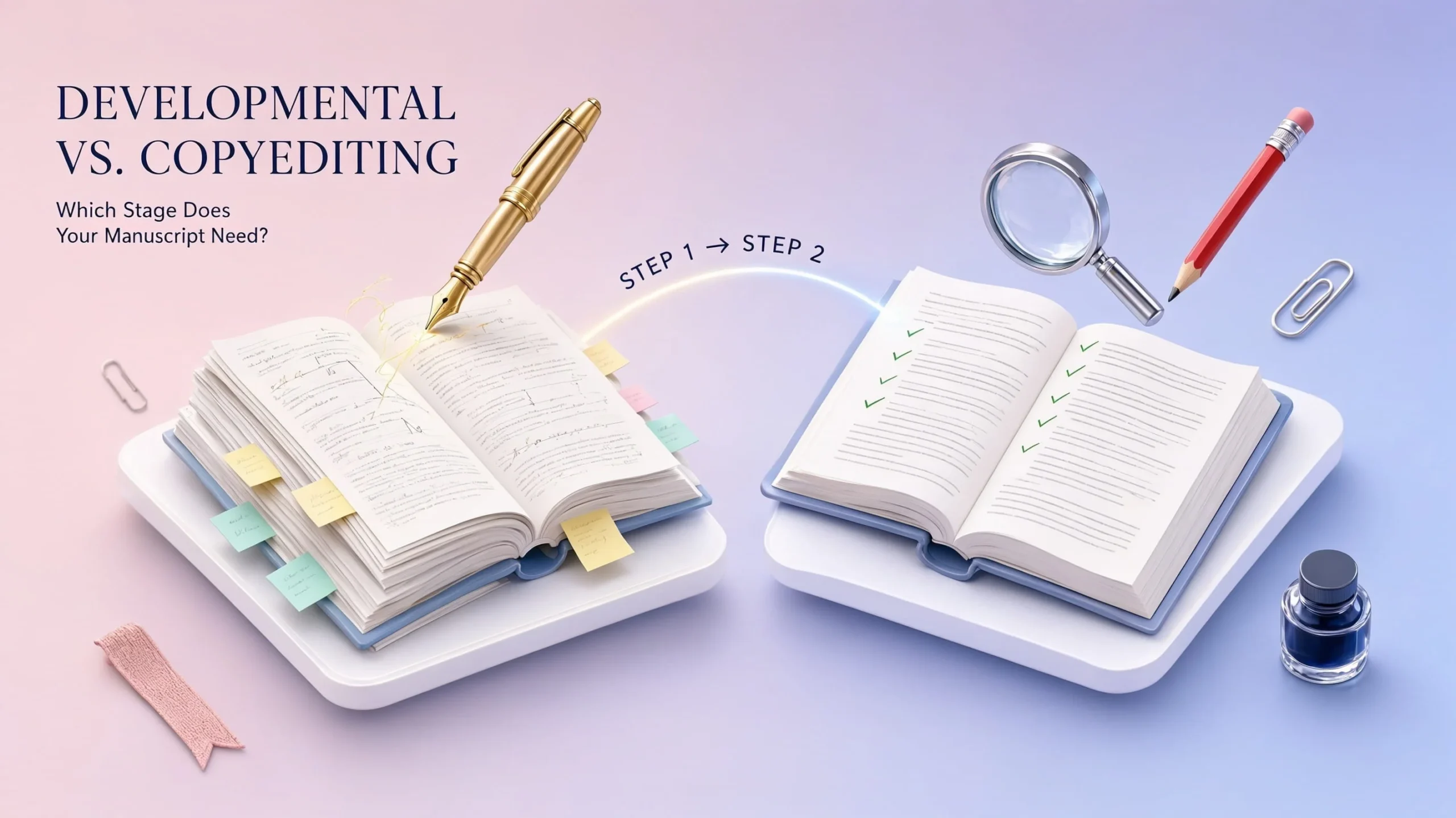
Authors reach out for editing help constantly using the wrong term for what they actually need, and it’s an honest mistake — the industry’s terminology isn’t exactly intuitive from the outside. Getting this distinction right before hiring anyone saves real money and, more importantly, saves a manuscript from getting the wrong kind of attention at the wrong stage.
What Developmental Editing Actually Addresses
Developmental editing operates at the structural level — the architecture holding your entire story up, not the individual bricks. A developmental editor looks at whether your plot actually makes sense from beginning to end, whether character motivations hold together across two hundred pages, whether pacing drags in the middle third the way manuscripts so often do, and whether your story’s central conflict resolves in a way that feels earned rather than convenient. This is big-picture work, and it frequently means substantial rewriting — cutting entire subplots, restructuring chapter order, deepening a character arc that reads thin in early drafts.
Plot Holes: The Structural Problem Developmental Editing Catches
A plot hole is a logical inconsistency significant enough that an attentive reader notices something doesn’t add up — a character who couldn’t plausibly know information they act on, a timeline that doesn’t actually work if you trace it carefully, a conflict that resolves through a solution the story never actually set up. These require structural fixes, not sentence-level polish. A developmental editor reads specifically for this kind of internal logic, tracking plot threads and character knowledge across the entire manuscript rather than focusing on any individual passage.
Character Arcs: Why This Requires a Full-Manuscript View
A character arc needs to develop believably across an entire book — the person readers meet in chapter one should feel meaningfully different, in a way that makes narrative sense, by the final chapter. Evaluating whether that arc actually lands requires holding the whole manuscript in mind simultaneously, tracking a character’s decisions, growth, and setbacks across every scene they appear in. This is fundamentally different work from checking whether any single scene is well-written in isolation.
What Copyediting Handles Instead
Copyediting operates at a completely different level: grammar, syntax, sentence structure, consistency in style and formatting, and clarity at the sentence and paragraph level. A copyeditor isn’t asking whether your plot holds together — they’re asking whether each individual sentence is doing its job clearly and correctly, whether your comma usage is consistent, whether you’ve accidentally changed a character’s eye color between chapter four and chapter nineteen.
Grammar, Syntax, and Sentence Flow Mechanics
This is the mechanical layer of editing: subject-verb agreement, correct punctuation, consistent tense usage, sentences that flow naturally rather than reading as awkward or overly complex. A copyeditor also watches for repetitive sentence structures — starting five sentences in a row with the same word, for instance — and repetitive word choice that a writer, deep in their own manuscript, has stopped noticing entirely.
Why the Order Matters More Than Authors Expect
Running copyediting before developmental editing is a genuinely common and costly mistake. Perfecting the grammar and sentence flow of a chapter that a developmental pass later determines needs to be cut, or substantially restructured, wastes real money and editorial time on work that won’t survive the bigger revision. Developmental editing should always come first, addressing the structural questions before any sentence-level polish gets applied to prose that might not make the final cut in its current form.
Figuring Out What Your Manuscript Actually Needs
If you’re getting feedback about pacing dragging, characters feeling flat, or a plot that doesn’t fully hold together, that’s a developmental editing problem, not a grammar problem — no amount of sentence polish fixes a structural issue underneath it. If your story structure feels solid but the actual prose reads clunky, inconsistent, or grammatically shaky, copyediting is the more targeted, cost-effective choice. Many manuscripts genuinely need both, in that specific sequence, but starting with an honest assessment of which problem you’re actually facing saves both money and a frustrating editing cycle that fixed the wrong layer first.