
Every self-published author reads their own manuscript more times than they can accurately count, and that repetition is exactly the problem the more familiar a passage becomes, the less your brain actually processes what’s literally written versus what it’s learned to expect. Here’s what consistently slips through as a result.
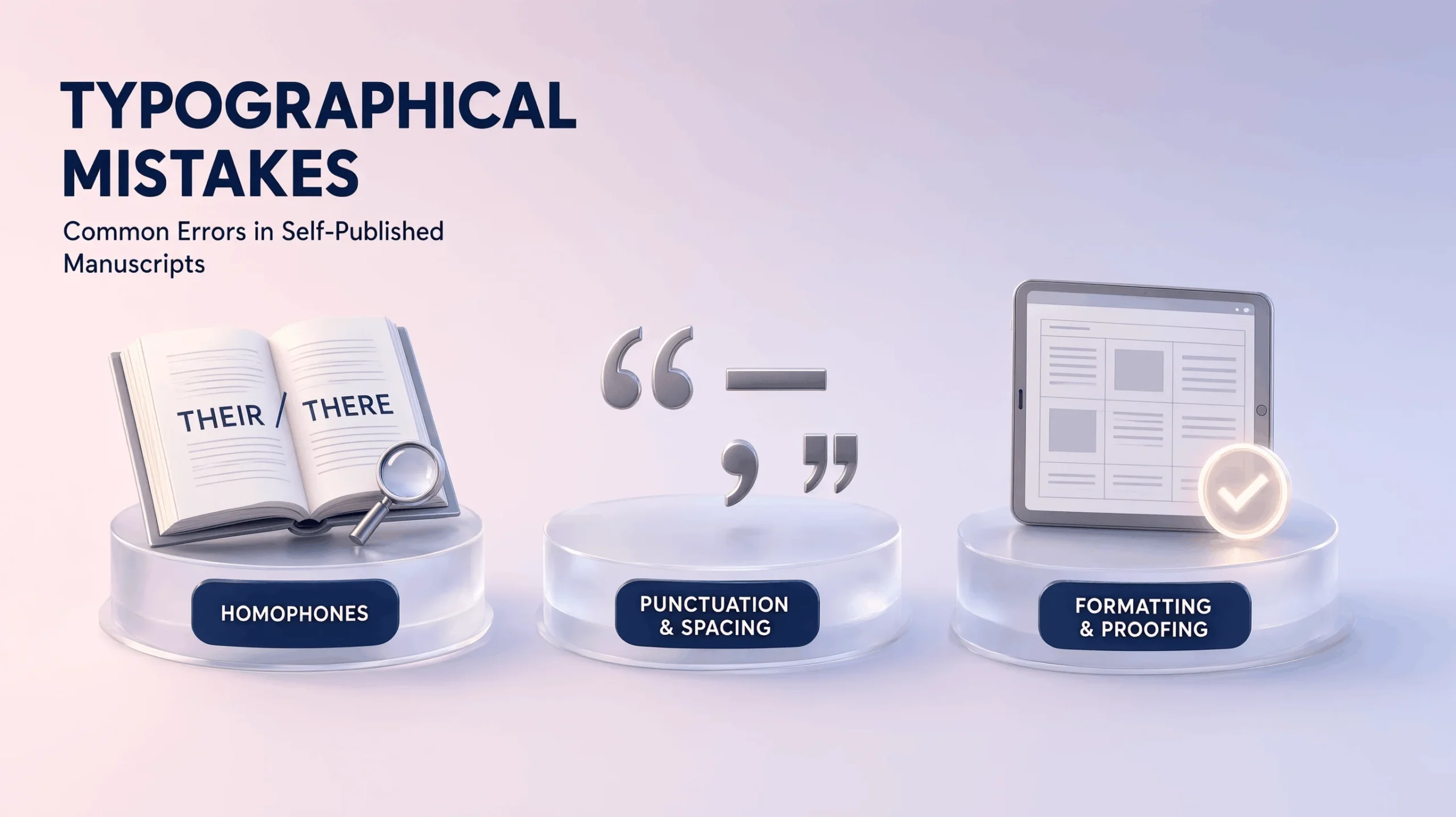
Homophones: The Errors Spell-Check Genuinely Can’t Catch
“Their,” “there,” and “they’re” are all correctly spelled words individually, which means a standard spell-check tool has structurally nothing to flag when one gets swapped for another. The same applies to “its” versus “it’s,” “your” versus “you’re,” and “affect” versus “effect.” These errors survive spell-check entirely intact and require either a human proofreader’s contextual reading or specific, deliberate attention during a dedicated review pass looking for exactly this category of mistake.
Punctuation Pitfalls That Compound Across a Manuscript
Inconsistent dialogue punctuation sometimes a comma before a closing quotation mark, sometimes a period, with no consistent rule applied throughout reads as sloppy even when each individual instance is arguably defensible in isolation. Em dashes and hyphens get confused constantly, semicolons get used correctly in some chapters and incorrectly in others, and apostrophe placement in possessives drifts inconsistently once an author’s stopped consciously double-checking the rule every single time.
Stray Double Spaces: A Small Error With Outsized Visual Impact
A holdover from an older typing convention many authors learned without realizing it’s since become outdated, double spaces after a period create small but genuinely visible gaps once a manuscript moves into its final formatted layout. These are invisible in a working Word document at a glance but become noticeably distracting once text is justified and laid out for actual print or digital publication, where consistent spacing carries real visual weight.
Formatting Inconsistencies That Erode Reader Trust Quietly
Chapter headings that shift in style partway through a book, inconsistent indentation, scene break symbols that appear in some chapters but not others these formatting inconsistencies don’t individually break comprehension, but they accumulate into a subtle, difficult-to-articulate sense that the book wasn’t handled with real care. Readers may not be able to name exactly what feels off, but the cumulative impression genuinely registers and shapes how they judge the book’s overall polish.
How Professional Proofreaders Actually Catch These Hidden Errors
Professional proofreaders read specifically for these categories rather than simply reading for enjoyment or general comprehension the way a typical reader would. This means deliberately slower reading, checking dialogue punctuation consistency across the entire manuscript in a dedicated pass, and running targeted searches for commonly confused homophone pairs rather than trusting a single read-through to catch everything by feel alone.
Why Authors Genuinely Can’t Catch All of This Themselves
This isn’t a knock on any individual author’s careful attention. It’s simply how human reading comprehension works extreme familiarity with a text measurably reduces error detection, a well-documented pattern that applies to every writer, regardless of skill level or how many times they’ve personally reread their own work. A fresh, professional set of eyes, trained specifically to look for these categories of error rather than just read for story, catches what familiarity has quietly made invisible to the person who wrote it.
Protecting Your Manuscript From These Specific, Predictable Errors
Understanding these common error categories doesn’t replace professional proofreading, but it does help authors do a more effective self-review before submitting a manuscript for that final professional pass cutting down on the volume of easily-caught errors and letting professional proofreaders focus their attention on subtler issues a self-review is genuinely less likely to catch on its own.